AI SRE
Autoheal's AI SRE works alongside your on-call rotation. It cuts through alert noise, drives investigations to root cause in minutes, and coordinates the mitigation.
The page covers two parts of that workflow:
- Incident Response: once an incident is declared, driving it from firefighting to resolution and prevention.
- Alert Intelligence: before an incident, turning thousands of raw alerts into a handful of events worth acting on.
Incident Response
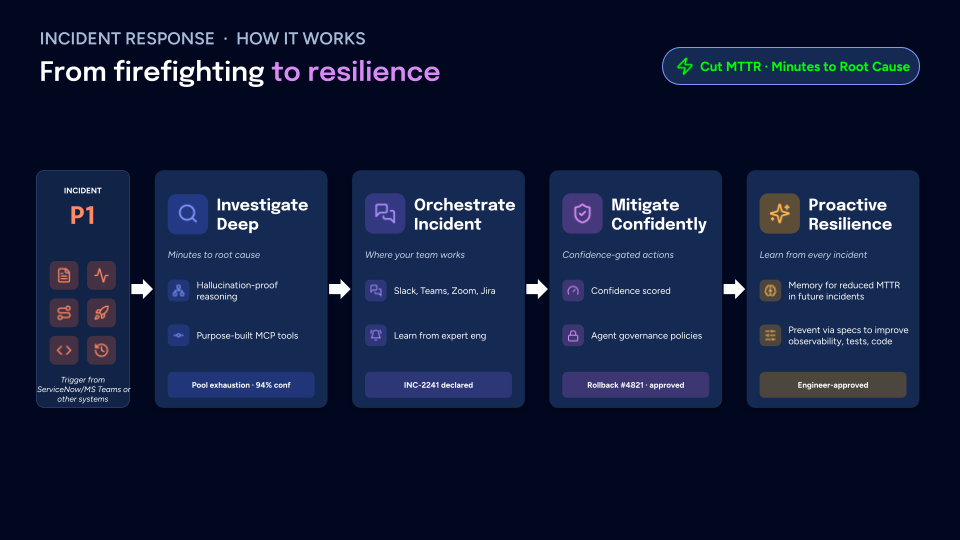
When a P1 is declared, triggered from ServiceNow, Microsoft Teams, or another system, Autoheal takes it from firefighting to resolution. The goal is to cut MTTR to minutes to root cause.
Investigate Deep
Incident Response defaults to a Deep investigation: the agent generates multiple hypotheses and cross-validates them, then returns a ranked root cause with a confidence score, such as "Pool exhaustion, 94% confidence." Every conclusion is grounded in evidence pulled from your systems and recorded in a decision trace, so you can audit how it reached the answer. The agent gathers that evidence through purpose-built MCP tools that query your observability, code, and infrastructure.
Orchestrate Incident
Autoheal coordinates the response in the tools your team already uses: Slack, Microsoft Teams, Zoom, and Jira. It declares and tracks the incident end to end (for example, "INC-2241 declared") and learns from your engineers as they collaborate, capturing how your team responds.
Mitigate Confidently
Remediations only proceed once they clear the bar you set. Every proposed action carries an explicit confidence score and is gated by the governance policies you define, so nothing risky runs unattended. Approved high-confidence actions are then executed, such as "Rollback #4821, approved."
Proactive Resilience
Each resolved incident makes the next one easier. Autoheal retains what it learned to reduce MTTR on the same service or failure mode next time, and it proposes changes to observability, tests, and code so the failure doesn't recur. Those preventive changes are surfaced for your team to review and ship.
Alert Intelligence
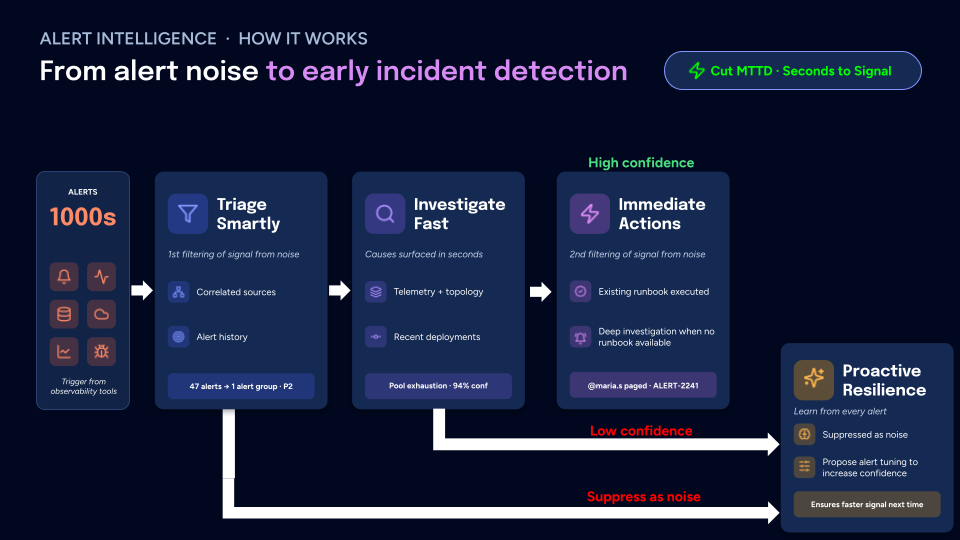
Before anything becomes an incident, Autoheal turns the thousands of alerts streaming from your observability tools into early detection. The goal is to cut MTTD to seconds to signal.
Triage Smartly
The first pass separates signal from noise. Autoheal correlates alerts that stem from the same underlying issue and weighs each against the alert history for that service. Thousands of raw alerts collapse into a handful of grouped, prioritized events, such as "47 alerts to 1 alert group, P2."
Investigate Fast
Alert Intelligence defaults to a Fast investigation: the agent pursues a single hypothesis for the quickest time-to-signal across high alert volume. For each grouped alert, it gathers context: telemetry and service topology, and the recent deployments that correlate with the alert timing. From that it surfaces a probable cause with a confidence score, such as "Pool exhaustion, 94% confidence."
Immediate Actions
The second pass decides what to do with the finding. When a known remediation applies, the agent runs the existing runbook. When no runbook is available, it opens a deeper investigation. If confidence is high, it acts or pages the right person, for example "@maria.s paged, ALERT-2241."
Proactive Resilience
Autoheal learns from every alert. Not every alert warrants a page, so it routes on confidence: high-confidence findings go to Immediate Actions, where the agent runs the runbook or pages the owner, while low-confidence findings and alerts that look like noise are suppressed. From those suppressed alerts, Autoheal proposes alert tuning to raise confidence, so the signal is cleaner and faster next time.
How It Integrates
The AI SRE works with your existing on-call workflow:
| Integration Type | Integration Examples | How Autoheal Uses The Integration |
|---|---|---|
| Alerting / On-Call | PagerDuty | Receives alerts and triggers investigations automatically |
| Observability | Datadog, Grafana | Queries metrics, dashboards, and monitors for evidence |
| Error Tracking | Sentry | Pulls error details, stack traces, and exception patterns |
| Source Control | GitHub, GitLab | Reviews recent deployments, commits, and PR history |
| Collaboration | Slack, Microsoft Teams | Invoked via @Autoheal to coordinate the response in-channel |
| ITSM / Incident | ServiceNow | Receives incident triggers and keeps records in sync |
| Logging | Elasticsearch | Searches logs for error patterns and anomalies |
Get Started
- Connect your monitoring tools (Datadog, Grafana, or similar)
- Set up PagerDuty for automatic alert-triggered investigations
- Add skills to your Production Context Graph for your most common alert types
- Connect Slack so your team can interact with investigations in real-time